

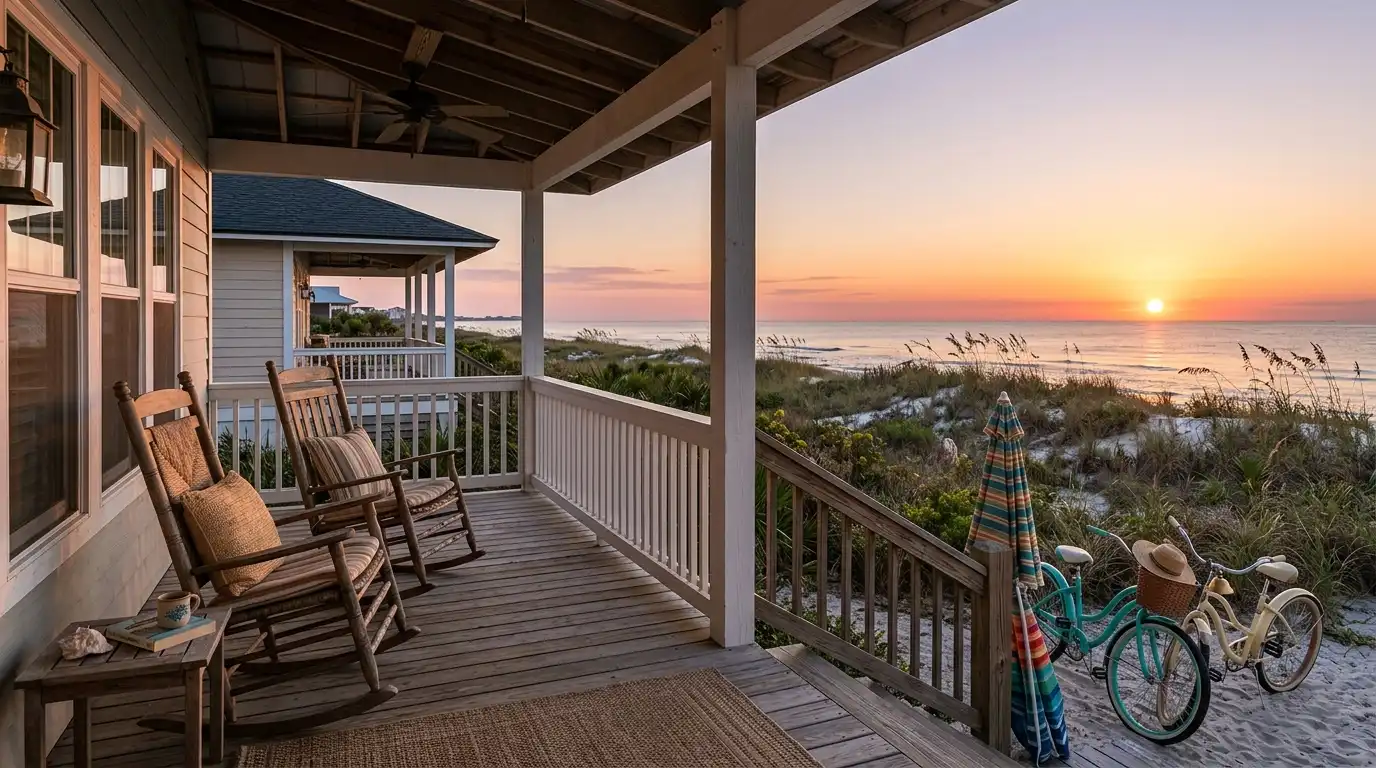
Many 30A buyers start as visitors: they vacation here, return, settle on a favorite community, and then weigh ownership. Decide first how the home will be used, as a vacation rental, a second home, a future retirement property or a permanent residence, because that choice drives the community, the rental rules and the tax treatment. A Florida second home gets no homestead exemption, and its non-school assessed value can rise up to 10 percent a year.
How visitors become owners on 30A
People often discover 30A as visitors before they become buyers. The progression is commonly: vacationing in the area, returning repeatedly, developing a preference for one community, considering whether ownership makes financial and lifestyle sense, and then deciding between a vacation rental, a second home, a future retirement property or a permanent residence.
The buyers we work with commonly come from Atlanta, Nashville, Birmingham, Dallas-Fort Worth, Houston, Memphis, Chicago, Louisville, Cincinnati, New York, Asheville, New Orleans, Baton Rouge and Napa Valley. Buying from another state puts three questions first: who looks after the home, what the community allows, and what it costs to carry. Our neighborhood guides cover each community.
Decide these first
The four uses lead to different communities, costs and tax treatment. If you expect the use to change, plan for the next one too.
| Use | What it changes | Check first |
|---|---|---|
| Vacation rental | Rental taxes apply to stays of six months or less; a rented home generally cannot carry homestead | Local and association rental rules, guest amenity access, projections from rental managers |
| Second home | Non-homestead property tax with a 10 percent annual cap on non-school assessed value | Insurance quotes, association and club costs, who looks after the home |
| Future retirement property | Taxed as a second home until it becomes your permanent residence on a January 1 | The homestead timeline, including Amendment 3’s proposed rule for new Florida residents |
| Permanent residence | Homestead exemption, the Save Our Homes cap, and portability from a prior Florida homestead | The March 1 homestead filing deadline and any Save Our Homes benefit you can bring |
If the home will rent
Short-term rental rules differ between Walton County, Bay County and the City of Destin, and a community association’s rules can be stricter than the local government’s. We confirm both for any specific property before you write an offer. One example of a community rule that is stricter than local government rules: the Watersound Camp Creek Property Report (effective July 24, 2025) says the community’s Declaration requires leases there to run at least 12 months. Per the WaterColor community association’s 2024-2025 guest materials, WaterColor rental guests could use the Beach Club once the owner completed an annual certification, the home was registered in the association’s Short-Term Rental Portal, and a nightly guest fee was paid; confirm the current rules with the association. Watersound Club says rental guests of its members may not use the club.
We work with several rental management companies and are not tied to any of them. When a buyer wants a rental projection, we request it from those companies; we do not produce or publish projections ourselves.
If it will become home later
A Florida homestead requires title and permanent residence on January 1 of the tax year, and the application, Form DR-501, is due to the county property appraiser by March 1. The first $25,000 of assessed value is exempt from all property taxes, and a second exemption, set at $25,000 and adjusted each January 1 for inflation, applies to assessed value over $50,000 for non-school taxes only. Save Our Homes then limits annual increases in assessed value to the lower of 3 percent or the change in the Consumer Price Index; the 2026 cap is 2.7 percent. A buyer leaving another Florida homestead can transfer up to $500,000 of accumulated benefit within the portability window.
Renting changes the answer. Renting all or substantially all of a homestead counts as abandoning it, although renting after January 1 does not cost that year’s exemption unless the home is rented more than 30 days per calendar year for 2 consecutive years.
Sources: Florida Statutes ss. 196.031, 196.011, 193.155 and 196.061 (2026); Florida DOR PT-113, PT-112 and Save Our Homes CPI table (January 2026); Watersound Camp Creek Property Report (July 24, 2025); WaterColor Amenity Wristband Access brochure 2024-2025; Watersound Club FAQ (January 24, 2025).
Property taxes on a second home in Florida
A second home is non-homestead residential property. It gets no homestead exemption, and its assessed value for non-school levies can rise no more than 10 percent a year under s. 193.1554, F.S. School levies are not capped. After a purchase, the assessment resets to just value, so the seller’s tax bill is not a guide to yours.
For tax year 2025, total millage in Walton County ranged from 8.0357 to 13.7417 mills, with 9.0357 mills in the South Walton Fire District, which covers most of unincorporated South Walton. The City of Destin was 11.8435 mills, unincorporated Destin Fire District 10.5165, and the City of Panama City Beach, which levies no city operating millage, 10.9139. A mill is $1 of tax per $1,000 of taxable value. Tax year 2026 rates are not final until the fall budget hearings.
In Walton County, TRIM notices with estimated taxes are mailed each August, tax bills go out before November 1, and non-ad valorem assessments appear separately on the bill. Beginning February 1, 2027, online listing platforms must show estimated taxes calculated on the listing price, or link to the property appraiser’s estimator, and may show the current owner’s taxes only as historical tax information.
Sources: Fla. Const. Art. VII s. 4(g); Florida Statutes ss. 193.1554, 689.261 (2026); Florida DOR, 2025 Taxing Authority Code Description Reports for Walton, Okaloosa and Bay counties; Walton County Tax Collector, Understanding Your Tax Bill (retrieved September 11, 2026).
Florida Amendment 3 in 2026: what it would change
Amendment 3 is a proposed property tax amendment to the Florida Constitution on the November 3, 2026 ballot. The Legislature passed it as CS/HJR 1-F in a special session on June 2, 2026, 75-26 in the House and 30-9 in the Senate. It takes effect only if at least 60 percent of voters approve it, and it would then take effect January 1, 2027. If approved, it would, among other changes:
- Lower the annual cap on increases in non-school assessed value for non-homestead property, including second homes, from 10 percent to 5 percent beginning January 1, 2027.
- Raise the homestead exemption for non-school levies to $150,000 beginning January 1, 2027 and $250,000 beginning January 1, 2028, indexed to inflation from 2029. The school-levy exemption would stay at $25,000.
- Give a person who had not kept a permanent Florida residence as of December 31, 2026 a $50,000 non-school homestead exemption, plus $25,000 for school levies, moving to the increased exemption beginning with the fifth year of exemption; the ballot summary says this applies to the extent permitted by the U.S. Constitution. From 2030, a county or city could shorten that wait by a two-thirds vote.
- Require a uniform procedure for counties and cities to raise the homestead exemption further, and limit what counties and cities may use property taxes for.
- Leave the Save Our Homes cap and portability in place.
After a Leon County circuit judge ruled on August 3, 2026 that the original ballot title and summary were defective, the Attorney General submitted a rewritten ballot statement on August 13, 2026, titled “Increased Homestead Exemption; Lower Cap on Increases in Non-Homestead Property Assessments.” The measure remains on the ballot.
Amendment 3 is a proposal. Until voters decide, the current rules apply, including the 10 percent non-school cap on second homes. We will update this guide after the election.
Sources: The Florida Senate, CS/HJR 1-F bill history and enrolled text (June 2026); Florida Division of Elections, Ballot Number 3; Office of the Attorney General letter (August 13, 2026); Fla. Const. Art. XI s. 5(e).
Tax on vacation rental income in Walton County, Destin and Panama City Beach
Florida has no state personal income tax. What a rental owner handles instead is tax on the rent: stays of six months or less carry the 6 percent state sales tax, the county surtax and the county tourist development tax. Walton County’s tourist development tax is 5 percent south of Choctawhatchee Bay and 3 percent north of it, charged on the rent plus required non-refundable fees such as cleaning, pet and resort fees.
| Area | State sales tax | County surtax | Tourist development tax | Combined |
|---|---|---|---|---|
| South Walton (including 30A) | 6% | 1% | 5% | 12% |
| Okaloosa County (including Destin) | 6% | 1% | 6% | 13% |
| Bay County district (including Panama City Beach) | 6% | 1% | 5% | 12% |
Registration is the owner’s or the manager’s responsibility. Anyone renting out transient accommodations registers with the Florida Department of Revenue, and so must a management company that collects rent for the owner. County tourist tax is filed separately with the Walton or Okaloosa County Clerk; in Bay County, administration and collection are moving from the Clerk to the Bay County Tax Collector as of October 1, 2026. In Walton, an owner whose manager remits the tax stays ultimately responsible if the manager fails to collect or remit it. Federal income tax on rental income is a question for your tax adviser.
Sources: Fla. Const. Art. VII s. 5(a); Florida Statutes s. 212.03(1)(a) (2026); Florida DOR GT-800034 (R. 10/25) and DR-15DSS (2026); Walton, Okaloosa and Bay County Clerk tourist development tax pages (retrieved September 11, 2026).
Buying a condo on 30A in 2026
Florida’s condominium structural-integrity laws date from 2022 and were amended in 2023, 2024 and 2025. For buildings three habitable stories or taller, a milestone inspection is due by December 31 of the year the building turns 30, then every 10 years, and the local building official may require it at 25 years where local conditions, such as proximity to salt water, warrant it. A structural integrity reserve study, or SIRS, is required at least every 10 years. Associations that existed on or before July 1, 2022 had to complete one by December 31, 2025; an association whose milestone inspection is due by December 31, 2026 may complete the SIRS with that inspection, but no later than December 31, 2026. For budgets adopted on or after December 31, 2024, owners may not vote to waive or reduce reserves for SIRS items.
As a buyer you receive, at the seller’s expense, the governing documents, the budget and financial statement, any milestone inspection summary, the most recent SIRS or a statement that none was done, and the FAQ, and you may cancel within 7 days, excluding weekends and legal holidays, after receiving them, unless they were delivered more than 7 such days before you signed; the right ends at closing. Use those days to read the budget, the SIRS and any special assessment or association loan, and the association’s rental rules.
In The Beasley Group’s Second Quarter 2026 Market Report, Destin recorded 143 condo and attached-home sales at an average of $611,477, and Alys Beach 12 at $4,068,335; the full report covers every community.
Sources: Florida Statutes ss. 553.899(3), 718.112(2)(f) and (g), 718.503(2) (2026); The Florida Senate bill pages for SB 4-D (2022), HB 1021 (2024) and HB 913 (2025); The Beasley Group, Second Quarter 2026 Market Report.
Insurance, flood and association costs
Consider flood exposure and wind exposure separately. Elevation, flood zone, construction type, age, roof, mitigation features and replacement cost all matter. In FEMA’s high-risk zones A, AE, V and VE, flood insurance is mandatory for buildings with federally backed mortgages in communities that participate in the National Flood Insurance Program, although NFIP premiums no longer rest on the flood zone. Citizens Property Insurance requires flood coverage on personal residential policies that include wind, other than condominium unit-owner policies, under a phase-in that reaches all remaining covered policies on January 1, 2027. More in our waterfront guide.
Association and club costs are community-specific. WaterColor Beach Club access comes with ownership through the community association. Watersound Club charges a non-refundable initiation fee and monthly dues it does not publish, and membership is mandatory with ownership in Watersound Camp Creek, where, under the community’s Declaration as described in the Camp Creek Property Report (effective July 24, 2025), resale buyers also pay a 0.50 percent transfer fee to The St. Joe Community Foundation. Our guides to WaterSound and WaterColor beach club membership and beach access in Walton County cover the details.
| Cost | How it works for a second home | Source |
|---|---|---|
| Property tax | No homestead exemption; non-school assessed value can rise up to 10 percent a year; 2025 total millage 9.0357 in the South Walton Fire District, 11.8435 in the City of Destin | s. 193.1554, F.S.; Florida DOR 2025 TACD reports |
| Wind and homeowners insurance | Priced on the property; insurer rate filings must include discounts for wind-mitigation features | s. 627.0629, F.S. |
| Flood insurance | Mandatory with a federally backed mortgage in high-risk zones; required on Citizens policies with wind, other than condo unit-owner policies, under a phase-in that completes January 1, 2027 | FEMA FloodSmart; s. 627.351(6)(aa), F.S. |
| Association and club | Set by each association or club; some clubs do not publish amounts | Community documents; Watersound Club FAQ |
| Rental taxes, if rented | 12 percent combined in South Walton, 13 percent in Okaloosa County, 12 percent in the Bay County district | Florida DOR; county clerks |
Sources: FEMA FloodSmart and NFIP’s Pricing Approach (updated April 9, 2026); Florida Statutes ss. 627.351(6)(aa) and 627.0629 (2026); WaterColor Amenity Wristband Access brochure 2024-2025; Watersound Club FAQ (January 24, 2025); Watersound Camp Creek Property Report (July 24, 2025).
When to shop for a home on 30A
Tourism season and real estate season overlap, but they are not the same. Official South Walton tourist development tax data shows June through August produced 49.1 percent of fiscal year 2025 collections, with July alone at 20.2 percent and January at 2.0 percent. Peak summer brings the highest concentration of potential buyers into the area, but it can be one of the hardest times to see heavily rented homes. Some of our best opportunities come in the fall and winter, when inventory is easier to show and both sides can make thoughtful decisions. A practical approach: spend time in your preferred communities in season, then tour homes in the off season.
Source: Walton County Clerk of Courts and County Comptroller, South Walton TDT Collection History, published by Walton County Tourism; fiscal year 2025 (October 2024 to September 2025). Collections are tax dollars, not visitor counts. Seasonality view: The Beasley Group.
Frequently asked questions
Should I buy a vacation home on 30A?
It depends on how you will use it. Decide first between a vacation rental, a second home, a future retirement property or a permanent residence, because each points to different communities, rental rules and tax treatment. Then compare carrying costs: property tax, wind and flood insurance, association or club costs, and rental taxes if it rents.
What should I know before buying a second home on 30A?
Know how you will use it, what the community allows, and what it costs to carry. A Florida second home gets no homestead exemption, and its non-school assessed value can rise up to 10 percent a year. Rental rules differ between Walton County, Bay County and the City of Destin, and association rules can be stricter.
How are second homes taxed in Florida?
A second home is non-homestead property. Its non-school assessed value can rise no more than 10 percent a year under s. 193.1554, school levies are not capped, and the assessment resets after a sale. Tax year 2025 millage was 9.0357 in the South Walton Fire District and 11.8435 in the City of Destin. A CPA or tax adviser can apply this to your own situation.
Can a second home get the Florida homestead exemption?
Only if it becomes your permanent residence. Homestead requires title and permanent residence on January 1, with the application filed by March 1. Renting all or substantially all of a homestead counts as abandoning it, and renting it more than 30 days per calendar year for 2 consecutive years can cost the exemption. A CPA or tax adviser can apply this to your own situation.
What is Florida Amendment 3 in 2026?
Amendment 3 is a proposed property tax amendment on the November 3, 2026 ballot, passed by the Legislature as CS/HJR 1-F. It would raise the non-school homestead exemption to $150,000 in 2027 and $250,000 in 2028 and cut the non-homestead assessment cap from 10 to 5 percent. It needs 60 percent voter approval to take effect.
How would Amendment 3 affect second homes on 30A?
If at least 60 percent of voters approve it, the cap on annual increases in non-school assessed value for second homes would drop from 10 to 5 percent beginning January 1, 2027. A buyer without a permanent Florida residence as of December 31, 2026 who later moves here would get a $50,000 non-school exemption until the fifth year of exemption, to the extent permitted by the U.S. Constitution, according to the ballot summary. A tax adviser can apply it to your situation.
Do I pay tax on vacation rental income in Walton County?
Florida has no state personal income tax, but stays of six months or less are taxed. In South Walton the combined rate is 12 percent: 6 percent state sales tax, 1 percent surtax and 5 percent tourist development tax. Owners or their managers register with the Florida Department of Revenue and the Walton County Clerk. Federal income tax on rental income is a question for your tax adviser.
What is the tourist tax on vacation rentals in Destin and Panama City Beach?
Okaloosa County, including Destin, levies a 6 percent tourist development tax, for a combined 13 percent with state sales tax and surtax. The Bay County district, including Panama City Beach, levies 5 percent, for 12 percent combined. Bay County collection is moving from the Clerk to the Bay County Tax Collector as of October 1, 2026. A tax adviser can confirm your filing obligations.
Can I rent out a second home on 30A?
It depends on the property. Short-term rental rules differ between Walton County, Bay County and the City of Destin, and a community association’s rules can be stricter than the local government’s. The Beasley Group confirms both for any specific property before you write an offer.
What should I know about buying a condo on 30A in 2026?
Buildings three habitable stories or taller need a milestone inspection by December 31 of the year they turn 30. Associations that existed by July 1, 2022 had to complete a structural integrity reserve study by December 31, 2025, or with a milestone inspection due by December 31, 2026 at the latest. Buyers may cancel within 7 days, excluding weekends and legal holidays, after receiving the association documents, unless they arrived more than 7 such days before signing; the right ends at closing. Consult a Florida real estate attorney.
When is the best time to shop for a home on 30A?
Some of our best opportunities come in the fall and winter. June through August produced 49.1 percent of South Walton’s fiscal year 2025 tourist development tax collections, and summer can be one of the hardest times to see heavily rented homes. In the off season, inventory is easier to show and buyers and sellers can make thoughtful decisions.
Where do The Beasley Group’s 30A buyers come from?
The Beasley Group’s buyers commonly come from Atlanta, Nashville, Birmingham, Dallas-Fort Worth, Houston, Memphis, Chicago, Louisville, Cincinnati, New York, Asheville, New Orleans, Baton Rouge and Napa Valley. People often discover 30A as visitors, return repeatedly, and settle on a favorite community before deciding to buy.
Related guides from The Beasley Group
- Waterfront Property on 30A and in Destin: Gulf-Front, Gulf-View, Lake, Bay and Harbor Compared
- Does a WaterSound or WaterColor Home Include Beach Club Membership?
- Public and Private Beaches on 30A: How Beach Access Works in Walton County
- Selling a Home on 30A: How to Price It, When to List, and How to Sell a Home That Rents
- What Makes a 30A Home a Luxury Home? The Seven Factors Behind the Price
- 30A and Destin Real Estate Market Report: Second Quarter 2026 by Community
- Buying with The Beasley Group
- 30A and Destin neighborhood guides
Find the 30A community that fits how you will use the home
Tell us how you plan to use a home on 30A, now and later. We will match that to the communities whose rules, costs and setting fit, and confirm the rental and association rules for any property you consider.
Start the conversation
Social Cookies
Social Cookies are used to enable you to share pages and content you find interesting throughout the website through third-party social networking or other websites (including, potentially for advertising purposes related to social networking).