

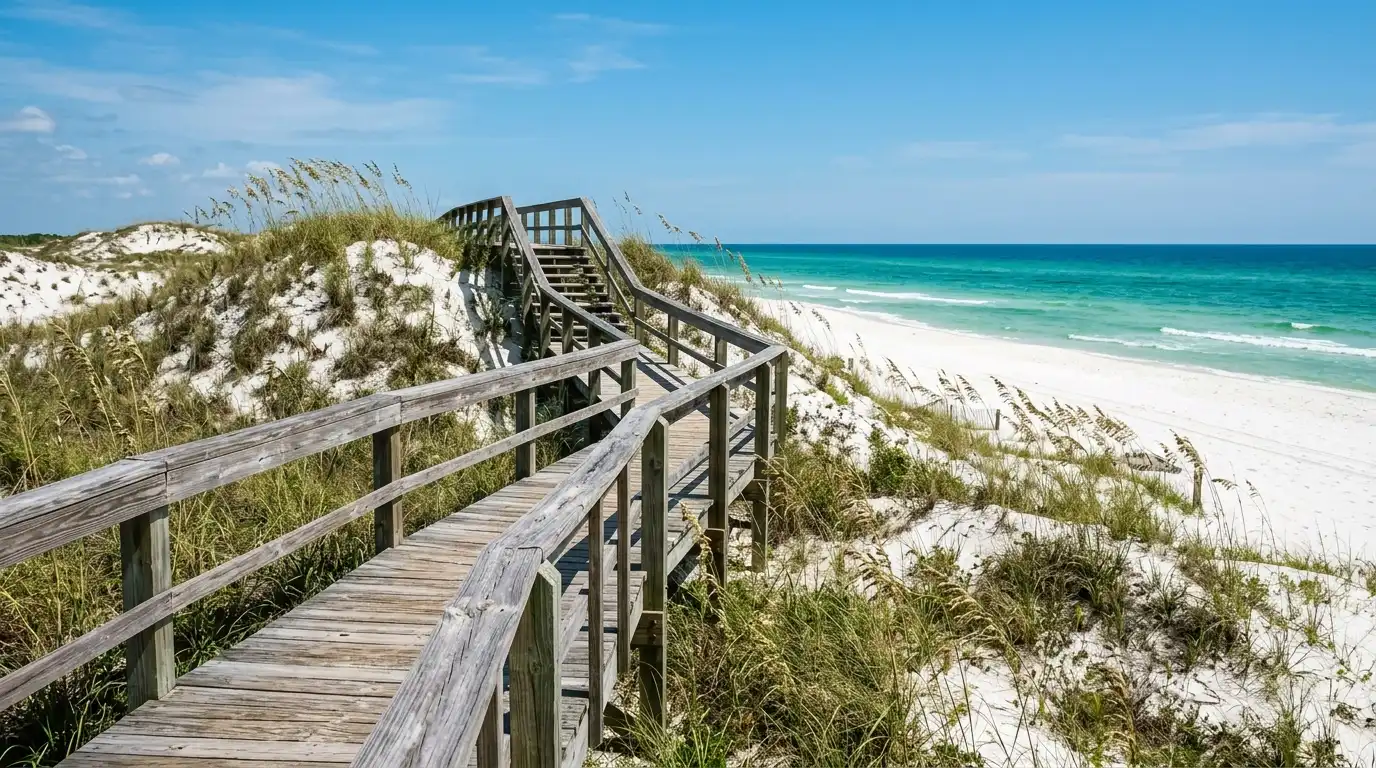
Both. Along all 26 miles of Walton County’s Gulf beach, the wet sand below the mean high-water line is public, as are public beach accesses, state parks and county- and state-owned beaches. Dry sand above that line is usually owned by the adjacent lot owner, and which stretches are private depends on the deed and survey. Whether any customary use rights apply to that dry sand is legally unsettled.
For beaches that come with a club, see our guide to WaterSound and WaterColor beach club membership. This guide covers public access and the county rules on the sand.
What is settled, and what depends on the deed
This guide is general information drawn from public sources as of September 29, 2026, not legal advice, and a Gulf-front buyer should have the survey and title reviewed by a Florida real estate attorney or title professional.
- The wet sand is public. The Florida Constitution holds the beach below the mean high-water line in trust for all the people, and Walton County’s tourism department says everyone can walk the wet sand along all 26 miles of the county’s beach.
- Public accesses and public land are public: county beach accesses, county- and state-owned beaches, and the Topsail Hill Preserve, Grayton Beach and Deer Lake state parks, which charge entry fees.
- Some renourished beach west of 30A is public. When Florida renourishes a beach, a fixed erosion control line becomes the boundary and the beach seaward of it belongs to the state. In 2018 the county’s Tourist Development Council said that applied to the stretch from Topsail Hill Preserve State Park west to the Okaloosa County line.
- Everywhere else, it depends on the deed. Florida Senate staff note that dry sand above the mean high-water line is usually owned by the adjacent lot owner. Whether a particular lot runs to the water is a title question.
Sources: Florida Constitution, Article X, Section 11; Florida Senate Committee on Rules, analysis of CS/SB 1622 (April 23, 2025); Visit South Walton, Beach and Bay Access Locations (map updated July 21, 2026); Walton County TDC statement (July 3, 2018).
Customary use in Walton County, 2016 to 2026
Customary use is the legal doctrine that if the public’s recreational use of dry sand has been “ancient, reasonable, without interruption and free from dispute,” the owner should not interfere with it. The Florida Supreme Court set that test in 1974, and courts apply it beach by beach. Walton County’s history with it:
- October 25, 2016: the county adopts a countywide customary use ordinance, amended March 28, 2017.
- July 1, 2018: HB 631 (chapter 2018-94) takes effect, barring customary use ordinances not based on a court declaration.
- December 11, 2018: the county sues for a declaration covering 1,194 private beachfront properties.
- February 2024: the represented owners who objected have either won dismissals with findings of no customary use on their beaches or settled, and the circuit court enters judgment on the 95 unrepresented parcels whose owners never objected.
- June 2025: Florida repeals the 2018 law when CS/SB 1622 (chapter 2025-178) is signed. According to Florida Senate staff, a local government may again declare customary use by ordinance, and an owner who disagrees must sue.
- February 18, 2026: Florida’s First District Court of Appeal, not the Florida Supreme Court, holds the 2024 judgment a nullity with no legal effect. Its opinion reports that at oral argument the county could not say whether the repeal revived its 2017 ordinance, maintained that the ordinance had been invalidated and was no longer in effect, and said it believed it could adopt a new one under home rule.
- May 26, 2026: the Board of County Commissioners adopts a resolution affirming its support for the public’s use of the beaches. It is a resolution, not an ordinance, and it does not declare customary use.
- August 25, 2026: the county adopts Ordinance 2026-10. No ordinance through that one is a new customary use ordinance.
So as of September 29, 2026, no new customary use ordinance appears in the county’s ordinance index, the 2024 judgment has no legal effect, and the appeals court did not decide whether the 2017 ordinance was revived. The county has said it could adopt a new ordinance, which owners could then challenge property by property. NPR called the result “a confusing patchwork of beach access” on September 4, 2026.
Sources: Florida Senate Committee on Rules, analysis of CS/SB 1622 (April 23, 2025); Florida First District Court of Appeal, Nos. 1D2024-0682, -0720, -0748 (February 18, 2026); Walton County Board of County Commissioners, public beach use resolution (May 26, 2026); Walton County Clerk ordinance index, through Ordinance 2026-10 (retrieved September 29, 2026); NPR (September 4, 2026).
Regional and neighborhood beach accesses
Walton County’s tourism department runs the official Beach and Bay Access map, which the county’s own Beaches page uses as the complete list. It shows more than 50 beach and bay accesses. Gulf beach accesses come in two kinds.
- Regional beach accesses are the large ones. There are 11, from Miramar Beach in the west to Inlet Beach in the east. They offer restrooms, parking, showers and bike racks, though amenities vary by access, and several have ADA access. Each has a surf-conditions flag and a lifeguard from March through October.
- Neighborhood beach accesses are smaller public accesses inside neighborhoods, reached by boardwalk and built mainly for walk-up traffic. There are dozens. Most have no parking, restrooms or lifeguards.
The newest, the county’s 11th, is the Bets “Beachmama” Haynes Regional Beach Access in Grayton Beach, opened June 15, 2026, with restrooms, rinse showers, an observation deck and a boardwalk to the beach tram. Some county pages still say nine regional accesses; that count is out of date.
| Regional access | Address | Notes |
|---|---|---|
| Dune Allen | 5999 W Scenic Hwy 30A | |
| Fort Panic | 5753 W Scenic Hwy 30A | |
| Ed Walline | 4447 W Scenic Hwy 30A | Serves Gulf Place. Parking, restrooms, bike racks, seasonal lifeguards. |
| Gulfview Heights | 186 Gulfview Heights St | |
| Blue Mountain | 2365 S Scenic Hwy 83 | |
| Bets “Beachmama” Haynes | 44 Hotz Ave, Grayton Beach | Opened June 15, 2026. No parking listed; reached from paid parking and the beach tram. |
| Santa Clara | 3468 E Scenic Hwy 30A | |
| Seagrove | 3910 E Co Hwy 30A | |
| Inlet Beach | 303 West Park Place Ave | Three sections, with parking. |
The other two, Miramar Beach and Scenic Gulf Drive, are in Miramar Beach. The map shows some communities, such as Seaside and Rosemary Beach, as private beaches with access for their guests, and its disclaimer says it “is not a legal representation of the features depicted.” Use it to find an access, not to decide whether a parcel is public.
Sources: Visit South Walton (Walton County TDC), Beach and Bay Access Locations and map data (updated July 21, 2026; access records retrieved September 11, 2026); WMBB (June 16, 2026).
Beach rules in South Walton
| Rule | What it says | Source |
|---|---|---|
| Leave No Trace | No personal property on the beach from one hour after sunset to one hour after sunrise without a county permit. Items left out are deemed abandoned and become county property. | Sec. 22-54(g) |
| Dogs | Banned except service animals and permitted dogs. Permits go only to Walton County real property owners or permanent residents. Leashed dogs allowed 3:30 p.m. to 8:30 a.m. Permits expire July 31; rabies proof required. | Sec. 22-31 |
| Tents and umbrellas | On county beaches, tents up to 10 by 10 feet, on the upland half of the beach except at Grayton Beach, 4 feet apart. Umbrellas up to 8 by 8 feet. Gear at least 15 feet from the dune vegetation line, toe of the dune or seawall. | Sec. 22-54(q), (r), (s) |
| Bonfires | South Walton Fire District permit. At least 200 feet from a marked turtle nest, 50 feet from the vegetation line, 100 feet from any habitable structure. Raised approved container and extinguisher. March through October, not before 5 p.m., cleared by midnight. No charcoal grills. | Sec. 22-54(b) |
| Beach driving | County permit required, in designated limited access areas only. Four-wheel drive, 5 mph. In turtle nesting season, no driving 10 p.m. to 8 a.m. except to launch or recover a boat. | Sec. 22-02, 22-57 |
| Fines | Civil infraction, fine up to $500. Each day of a continuing violation is a separate offense. Entering the water under a double red flag can bring a $500 fine. | Sec. 22-62; county flag legend |
The ordinance also bans glass containers, unattended holes or holes deeper than 2 feet, removing sand, overnight camping and personal fireworks on county beaches. Sea turtle nesting season runs May 1 to October 31, and tents go on the upland half, not the upper third older pages mention.
Sources: Walton County Ordinance 2025-22, amending Chapter 22 (adopted November 24, 2025); Walton County Bonfire Rules and Permits page (retrieved September 11, 2026).
Driving on the beach at Grayton
The ordinance lists four designated areas for permitted vehicles. In practice Grayton Beach is the only open one: Inlet Beach allows boat launching only, and Walton Park and Seagrove Beach are temporarily closed.
- The lottery. Walton County may issue up to 150 additional one-year, nonrenewable permits each year. Applications run April 1 to May 10, the drawing is the third Tuesday in May, and winners have 30 days from June 1 to buy.
- Who can enter. Only Walton County residents: registered voters or property owners who live in the county. A second-home owner who lives elsewhere can drive only on a grandfathered, nontransferable permit renewed every year.
- Vehicles. Four-wheel drive and registered for highway use; lottery and disability permit vehicles and trailers must be registered in Florida. No ATVs.
- 2026 fees. A grandfathered permit costs $135, plus $40 for a launch decal. A charter vehicle permit costs $210, plus $40 for the trailer.
- Charters. Up to 15 charter fishing beach permits go to county-resident licensed captains, and fishing charters launch off the sand at Grayton.
Sources: Walton County Ordinance 2025-22, Sec. 22-02 and 22-57 (adopted November 24, 2025); Walton County Code Compliance, Beach Driving, Charter Fishing, Dog Beach Permits page and 2026 Beach Charter and Launch Application (retrieved September 11, 2026).
Parking for the beach
Walton County began paid beach parking on April 3, 2026, at three county lots: Van Ness Butler, County Road 393 and Grayton Beach. The former Van Ness Butler beach access between Seaside and WaterColor is now owned by WaterColor and limited to its homeowners, so check which access a lot serves before you park. From March through October, parking costs $5 an hour or $15 a day, and $5 a day in winter. Annual passes cost $5 for Walton County residents and $205 for non-residents, plus a $3.50 fee per vehicle, and a weekly visitor pass is $90. Beach trams are free, overnight parking is banned in county beach access lots, and the program may add lots, so check parkwaltonco.org.
Sources: Park Walton County, locations, passes and FAQ pages (retrieved September 29, 2026); WJHG (April 3, 2026); Walton County Code Sec. 22-61; WaterColor Community Association FAQ and Seaside, Commonly Asked Questions (May 10, 2024), on the former Van Ness Butler access.
Buying on the Gulf: a property question and a legal question
Whether a Gulf-front lot includes the sand in front of it is decided by the deed, the survey and, where one exists, the erosion control line. On April 15, 2026, the First District Court of Appeal sent a Dune Allen case back to the trial court over whether deeds written from 1964 to 1970, which set the southern boundary by a measured 315-foot call from Highway 30A and never mention the Gulf, reach the water. This guide is general information, not legal advice: for any Gulf-front purchase, have a current survey and the title reviewed by a Florida real estate attorney or title professional.
Source: Florida First District Court of Appeal, No. 1D2025-0984 (April 15, 2026).
Frequently asked questions
Are the beaches on 30A public or private?
Both. The wet sand below the mean high-water line is public along all 26 miles of Walton County’s Gulf beach, and anyone can walk it. Public beach accesses, state parks and county- and state-owned beaches are public too. Dry sand above that line is usually owned by the adjacent lot owner, according to Florida Senate staff, and whether a stretch is private depends on its deed, survey and any erosion control line.
What is customary use in Walton County in 2026?
Customary use is the doctrine that long-standing public recreational use of dry sand can protect that use against the owner. Florida repealed its 2018 customary use law in June 2025, and on February 18, 2026 an appeals court held the 2024 circuit court judgment a nullity. The county told that court its 2017 ordinance is no longer in effect but could not say whether the repeal revived it. No new ordinance had been adopted as of September 29, 2026.
Did the Florida Supreme Court rule on Walton County’s beaches in 2026?
No. The February 18, 2026 ruling came from Florida’s First District Court of Appeal, not the Florida Supreme Court. The court held that the February 2024 circuit court judgment declaring customary use on the remaining Walton County parcels is a nullity with no legal effect, because Florida repealed the 2018 customary use law in June 2025.
Where are the public beach accesses on 30A?
On the county tourism department’s Beach and Bay Access map at visitsouthwalton.com. Regional accesses on or near 30A include Dune Allen, Fort Panic, Ed Walline, Gulfview Heights, Blue Mountain, Bets Beachmama Haynes in Grayton Beach, Santa Clara, Seagrove and Inlet Beach. Dozens of smaller neighborhood accesses sit between them, and three state parks also have beach access.
What is the difference between a regional and a neighborhood beach access?
Walton County’s 11 regional beach accesses are the large public accesses, offering restrooms, parking, showers and bike racks, though amenities vary, with a surf-conditions flag and lifeguards from March through October. Neighborhood beach accesses are smaller public accesses inside neighborhoods, reached by boardwalk and designed for walk-up traffic. Most neighborhood accesses have no parking, restrooms or lifeguards.
Can you drive on the beach in Grayton Beach?
Yes, with a Walton County beach driving permit. Grayton Beach is the one open area where permitted vehicles drive on the sand. Only Walton County residents can enter the annual lottery for up to 150 one-year permits, so second-home owners who live elsewhere are excluded unless they hold a grandfathered permit. Vehicles must be four-wheel drive, lottery permit vehicles must be registered in Florida, and the speed limit is 5 mph.
Can I bring my dog to the beach in Walton County?
Only a service animal or a dog with a county permit. Dog beach permits are issued only to Walton County real property owners or permanent residents, so an owner of a second home in the county can apply but a vacation renter cannot. Permitted dogs must be leashed and are allowed on the beach from 3:30 p.m. to 8:30 a.m. Permits expire July 31.
What are the main beach rules in South Walton?
Under Walton County’s 2025 beach ordinance, nothing may be left on the beach from one hour after sunset to one hour after sunrise without a permit. On county beaches, tents are limited to 10 by 10 feet on the upland half of the beach, except at Grayton Beach. Bonfires need a South Walton Fire District permit. Glass, unattended holes and overnight camping are banned, and fines run up to $500.
Where do you park for the beach on 30A?
At a regional beach access lot or a county paid lot. Walton County started paid beach parking on April 3, 2026 at the Van Ness Butler, County Road 393 and Grayton Beach lots, at $5 an hour or $15 a day from March through October. Annual passes cost $5 for county residents and $205 for non-residents, plus a fee. The former Van Ness Butler beach access now belongs to WaterColor, for homeowners only, so check which access a lot serves. Beach trams are free, and overnight parking is banned.
How do I know whether a Gulf-front home includes the beach?
Read the deed and the survey, not the map, which says it is not a legal representation. The mean high-water line, or a fixed erosion control line where a beach was renourished, marks the public boundary. Whether an older deed reaches the water can be disputed: in April 2026 an appeals court sent a Dune Allen case back for trial on that question. For a Gulf-front purchase, get a current survey and title review, and ask a Florida real estate attorney.
Related guides from The Beasley Group
- Does a WaterSound or WaterColor Home Include Beach Club Membership?
- Living in Grayton Beach, Florida: A Buyer’s Guide to Old 30A
- Waterfront Property on 30A and in Destin: Gulf-Front, Gulf-View, Lake, Bay and Harbor Compared
- Buying a Second Home on 30A: How Visitors Become Owners and What to Decide First
- Gulf Place homes and community guide
- Dune Allen homes and community guide
- Inlet Beach homes and community guide
- Santa Rosa Beach homes and community guide
Ask how the beach works for a specific address
Send us the address. We will pull what the deed and survey show, find the nearest public access, and tell you what needs a title or legal review before you buy.
Ask about beach access for an address
Social Cookies
Social Cookies are used to enable you to share pages and content you find interesting throughout the website through third-party social networking or other websites (including, potentially for advertising purposes related to social networking).